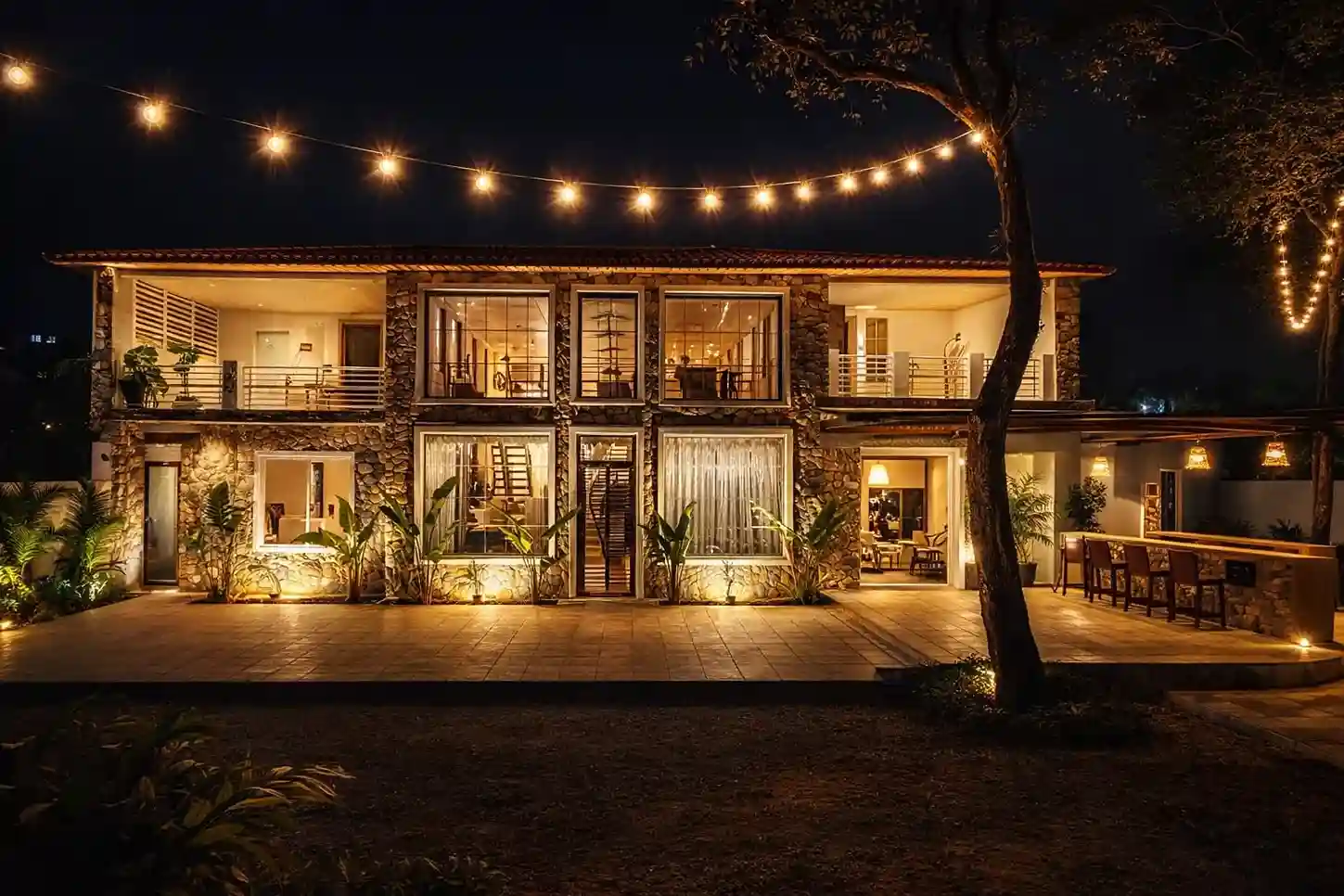

Floor-to-ceiling glass and pine-forest views from the bedroom at Glass Room with Balcony, Jibhi
The first thing I heard was the river. Not an alarm, not traffic, not a phone. Just water moving over stones somewhere below the glass, steady and unhurried, as if it had been talking all night and I had only just started listening.
I had booked a tree house in Jibhi on a whim. Three nights, no itinerary, a bag that was mostly sweaters. A friend had sent me a photo of a triangular glass cabin tucked into the pines and written one line under it: “You need this.” She was right.
Tree House Jibhi: Getting There
Jibhi sits in the Banjar valley of Kullu district in Himachal Pradesh, a small village of wooden houses, apple orchards and cedar forest. Most people arrive the way I did: an overnight Volvo from Delhi to Aut, then a taxi up the valley for the last stretch. The drive from Aut takes roughly an hour and a half, the road narrowing as it climbs, the Tirthan and Banjar streams keeping you company most of the way.
If you are flying, Bhuntar airport near Kullu is the closest, around 60 km away. Either way, plan to arrive in daylight. The last few kilometres are beautiful, and you will want to see them.
The First Evening
The cabin was everything the photo promised and a little more. A steep A-frame roof, a wall of glass facing the forest, and a small balcony where I spent far more time than I spent inside. By the time I had unpacked, the light had turned gold on the ridge across the valley and the temperature had dropped enough to make the blanket on the bed look very appealing.
What surprised me was the quiet. In a city you stop noticing noise because it never stops. Here, every sound was distinct: a dog barking in the village, a pressure cooker whistling in someone’s kitchen, wind moving through the deodars. I made tea, sat on the balcony and watched the stars come out one by one until there were too many to count.
Day Two: Waterfall, Village, River
I woke early, partly from excitement, partly because the glass lets the morning in whether you are ready or not. After breakfast I walked to Jibhi waterfall, a short, easy trail through the forest that ends at a pool so clear you can see every pebble. In the afternoon I wandered through the village, past old houses built in the traditional kath-kuni style of stone and timber, and ended up sitting by the river for an hour doing absolutely nothing.
That evening I met a family staying at the riverside homestay down the road. Their children had spent the day building stone dams in the shallows and were still wet to the knees. We shared a bonfire and talked about how rare it is to have a day with no plan at all.
Day Three: Jalori Pass and Serolsar Lake
On my last full day I took a taxi up to Jalori Pass, roughly 3,100 metres above sea level and about an hour’s drive from Jibhi. From the top, a gentle trail of around five kilometres leads through oak forest to Serolsar Lake, a small, still lake with a temple at its edge. The walk is mostly level and very peaceful. In winter the pass can close after heavy snowfall, so check conditions before you go.
Coming back down, the valley looked different. Greener, softer, more like home. I was already planning my next visit before the taxi reached the cabin.
Why the A-Frame Cabins in Jibhi Feel Different
Back at the cabin that evening, I finally worked out why it felt so good. It was the shape. An A-frame is really just a roof that comes all the way down to the ground. The two steep sides meet at a point high above you, so the space feels snug at the edges and tall in the middle. Rain and snow slide straight off. At the front, where a wall would normally block the view, there is glass.
You live differently in a room like that. You sit by the glass instead of in front of a screen. You notice the weather moving across the hills. When it gets cold you head outside to the bonfire rather than closing the curtains, and that’s when the stay starts to feel like a tree house Jibhi trip and not just a hotel night in the mountains.
What You Get at the A-Frame Glass Treehouse Cabins
The Vacay Homes lists the A-Frame Glass Treehouse Cabins in Jibhi. Here is what the listing includes:
1 bedroom and 1 bathroom, sleeping up to 4 guests per cabin
From ₹7,500 per night (hotel tax extra)
Mountain views, a hammock and an outdoor sitting area
Outdoor dining and a bonfire for cold evenings
Heating, hot water and power backup, which matter in the hills
A kettle with tea, plus toiletries
A caretaker on site and private parking
Check-in from 1 PM, check-out by 11 AM
Who an A-Frame Cabin Suits
Couples: the glass front and the hammock are made for slow mornings and long evenings with nowhere to be.
Two or three friends: small enough to feel cosy, with room for everyone’s sweaters.
A small family of four: children love the shape, and bonfire nights become the story they tell back home.
Larger groups: the listing calls them cabins, in the plural, so message us to check whether more than one is free for your dates.
Tree House Jibhi Stays: Which One Should You Book?
If my story has you reaching for your calendar, here are the stays in Jibhi that capture the same feeling. Each one is listed and verified by The Vacay Homes.
A-Frame Glass Treehouse Cabins
The closest thing to the cabin in my story, and the one I would book again. Steep A-frame roofs and glass fronts among the trees, with a hammock outside and a bonfire when the evening turns cold. It’s the most complete tree house Jibhi experience on our list.
1 bedroom, 1 bathroom, up to 4 guests
Starting from ₹7,500 per night (hotel tax extra)
Mountain view, hammock, bonfire, heating, caretaker on site
Glass Room with Balcony
A glass room with its own balcony, ideal for couples or a small group who want forest views without giving up comfort.
Listed for up to 3 guests
Starting from ₹4,900 per night
A Few Things I Wish I Had Known
Pack layers. Even in summer, nights in Jibhi are cool, and glass cabins feel the temperature change quickly.
In an A-frame the walls slope inwards, so there is less headroom at the sides. Soft bags fit under the eaves far better than hard suitcases.
Glass loses warmth quickly after dark. The A-frame cabins list heating, but bring a warm layer for sitting by the bonfire.
Carry some cash. Mobile payments work in most places, but network can drop in the valley.
Download your maps and music before you leave Aut.
Book weekends early. The best tree house stays in Jibhi fill up fast from April to June and again around the October holidays.
Give yourself at least three nights. The first day is for arriving, the last is for leaving, and the one in the middle is where the magic happens.
Your Turn
I went to Jibhi for a break and came back with something harder to name: a reminder that I do not need much to feel good. A warm bed, a view, a river and time. If you are ready for the same, our team will help you pick the right tree house Jibhi stay for your dates and your people.
Explore all our stays in Jibhi or chat with us on WhatsApp to check availability.